jeudi 13 décembre 2012

Gwalior


Gwalior, "petite" ville de 1 million d'habitant, au nord de l'Etat du Madhya Pradesh.
Parfaite destination au sud de Delhi pour un petit weekend au soleil, entre visites culturelles et... développement urbain!


Rénovation d'un bidonville en parc et zone de captage d'eau


Superbe site de sculpture Jaïn du 15ème siècle dans la roche Ek Patthar Ki Baoli


Bouddha assis vu d'en dessous


Le "baoli" ("stepwell" ou "puit à marches" ou encore source) en question:


C'est beau, mais faut pas craindre les abeilles...

Mise à l'honneur... pour avoir admirer le site? ils ne doivent vraiment pas avoir beaucoup de touristes... (en même temps, le Guide du Routard ne mentionne pas le site...)


Accueil chaleureux dans la famille de Krishna, Ingénieur en Développement Urbain qui fait des merveilles dans la ville


Jai Vilas Mahal, Palais de la dynastie Scindia, qui renferme des tonnes d'or et de cristal...


Salle à manger royale avec petit train en argent qui sert liqueurs et cigarettes aux convives
 
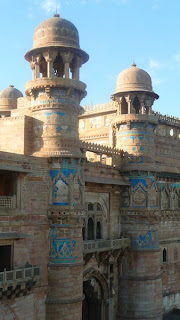
 Fort de Gwalior, merveille du 15ème siècle qui surplombe la ville et tire son nom de celui qui aurait guéri la lèpre


Rénovation en cours

Palais du roi Man Singh, à l'intérieur du fort


Symbols de l'Inde et de la royauté: la chimène à trompe d'éléphant, corp de lyon et pattes de cheval
Le paon

La rosace et le triangle représentant les 3 dieux Bhrama, Shiva, Vishnu et leur histoire
10x3 fenêtre pour représenter les 33 millions de Dieux hindous (et les vénérer tous en un tour de salle, quand on dit que les Indiens sont des feignasses...)


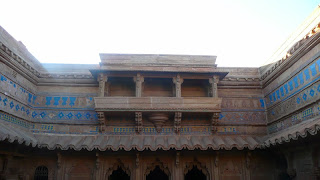

Couché de soleil sous un ciel bleu et de magnifiques monuments ocres, que demander de mieux pour la photo?


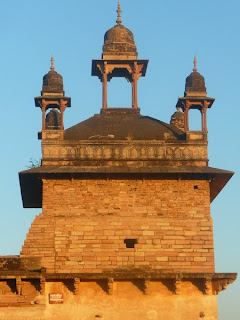


Vue sur la ville et le Palais de la 9ème femme du roi, villageoise qui avait demandé à ne pas être traitée comme les 8 autres, c'est à dire ne pas être enfermée cachée du regard des hommes, partir au combat avec son mari, et avoir l'eau de la rivière de son village, qui la rende si belle et si forte, amenée au fort par gravité. rien que ça! et on dit que les femmes modernes son difficiles!

Mosquée


Teli Ka Mandir, temple Hindou typique d'Inde du Sud...

...Avec entrée typique du nord, et en face d'une Gurdwara, temple Sikh...
... et de temples Jaïn.
Quand on dit que les religions cohabitent en Inde...


Sculptures Jaïn dans la roche, le long de l'ascension vers le fort


Passage de nuit à la Gurdwara, en attendant le spectacle de son et lumières


Gwalior de nuit


Visite matinale d'un bidonville sacrément bien entretenu! (je soupçonne le coup de fil aux balayeurs avant notre arrivée...)


Evacuation des eaux usées
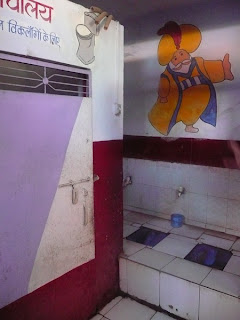
Latrines communautaires avec abonnement/paiement mensuel.
Pour hommes/femmes/enfants/handicapés, et même douche!

Toilette spéciale femmes réglées pour déposition des serviettes hygiéniques


Place du village pour les activités communautaires


Avec la femme de ces lieux
et les animaux domestiques...


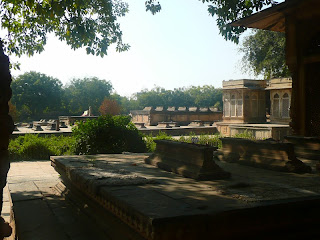
La tombe de Mohammad Ghaus, Guru du grand musicien Tansen


Tombe de Tansen


vendredi 7 décembre 2012

Et si on cherchait où est le VRAI problème?


Indian village bans mobile phone use by women

PATNA, India - Dec 5 (Reuters) 

A village council in the eastern Indian state of Bihar has banned the use of mobile phones by women, saying the phones were "debasing the social atmosphere" by leading to elopements - a move that set off outraged protests from activists.

In addition to the ban, the Sunderbari village council in a Muslim-dominated area some 385 kilometers (239 miles) east of Patna, the capital of Bihar, has also imposed a fine of 10,000 rupees ($180) if a girl is caught using a mobile phone on the streets.
Married women would have to pay 2,000 rupees ($36.60). 
 
 
"It always gives us a lot of embarrassment when someone asks who has eloped this time,"? said Manuwar Alam, who heads a newly-formed committee tasked with enforcing the ban, referring to queries from neighbouring villages.
He said the number of elopements and extramarital love affairs had risen in the past few months, with at least six girls and women fleeing their homes.
"Even married women were deserting their husbands to elope with lovers. That was shameful for us," Alam said. "So, we decided to tackle it firmly. Mobile phones are debasing the social atmosphere"?. 
 
 
Local officials have begun investigations, saying that such bans cannot be allowed in a healthy society, while women's rights activists called it an assault on freedom that could potentially end up harming women by stripping them of one source of protection from trouble, such as unwanted advances by men.
"Girls and women are capable enough to protect themselves," said activist Suman Lal during a debate on local television. "Technology is meant to be used, not to be banned...The order is nauseating."
Fellow activist Mohammad Islam said it was "disappointing" that the village council ignored the many advantages of mobile phones before placing a ban on them for one reason.
"I want every girl to be given a mobile phone so that she could call up family members if she has a problem"?, he said. 

jeudi 6 décembre 2012

Do you really think that God wants THIS???


Three festivals have come and gone, and our rivers are the filthier for them. Ganesh Chaturthi, Durga Puja and Chath Puja left their mark yet again on the already filthy waterways in the shape of plastic bags, broken idols and oil from lamps. The usual rounds of newspaper reports appeared and went. I went to the Yamuna river front the other day – the only form of human waste missing was shit, presumably because I was on the Chath Puja ghat. The water stank; the banks were covered with plastic, idols and other sundry puja leftovers.


There is something intrinsically wrong with a country that rushes to immerse gods in filthy rivers in a ritualistic belief, but is blind to the systematic decimation of its rivers, lakes and ponds. The least one would expect is common decency in the form of sensitivity to the plight of water ways, and a common agreement to remove the idols once rituals are satisfied. But no, the story gets worse year after year. Durga Puja samitis, Ganesh Chaturthi processions and Chath Puja organizers compete to make more and larger idols, and each is accompanied by the collaterals of prayer. The idols are covered with paints containing heavy metals. Together with the other debris, they combine to form a deadly cocktail.


Things do not have to be this way in this day and age. Pollution from religious practices can be mitigated very simply – create an inventory of the source and develop a water quality monitoring mechanism. Experts, the government and religious leaders can sit together to work out an action plan to minimize pollution that includes identifying immersion points and construction of separate sites separated by the main water body to contain idols and other detritus. Water in this isolated site can be treated before release into the river or lake.

People need to learn what their religious fervor does to their water through an intelligent and balanced media campaign. Those responsible for idol immersion must be mandated to clean up afterwards – remove every bit of garbage and all idols as quickly as possible after the event, or employ local rag pickers, and totally ban the public from throwing plastic into the water. This has happened at a few sites in India: near Sabarimala in Kerala that is visited by lakhs of pilgrims every year, people throw their old clothes in the nearby River Pampa and defecate on its banks even though there are toilets. The river is the only source of drinking water for the locals. The authorities also set up wire meshes to stop the clothes from flowing down the river. Along with this end-of-pipe approach, idol-makers must be taught not to use synthetic paints but only natural colours.


Recently, during Ganesh Chaturthi in Delhi, an NGO, the government and religious leaders ensured the floral offerings are composted instead of being thrown into the Yamuna River. The NGO ran an awareness and participation for the youth and identified practices that would not hurt people’s religious sentiments. Another campaign in Delhi called the Eco-Visarjan Campaign, advocated the use of clay idols painted with natural colours. In Hyderabad, people immerse Ganesh idols in the Hussain Sagar lake. The problem is more from the plastic bags and the paint used. In 2009, the West Bengal Department of Environment took up the idol issue with paint manufacturers, who agreed to produce only lead-free paints. Puja pandals also bought idols coloured with these paints and the Kolkata municipality provided many dust-bins for people to throw their solid waste. The Hooghly River breathed a lot easier.


In Pune, during the 10-day Ganesh festival, the Pune Municipal Corporation provided large bins along the river for people to throw flowers and other offerings. They also provided large water tanks for idol immersion. They also ran an awareness campaign to inform people about these facilities, instead of following their regular practice of immersing idols in the river. The city’s twin rivers were the better for it. In Karnataka, the state pollution control board has issued guidelines for immersing idols in the sea that state this activity can take place 500 m beyond the low-tide level, and the idols should be made of clay and painted with natural colours. The Bangalore municipal corporation has created an artificial pond near the Halsuru Lake for idol immersion. A little common sense can help; use clay idols, use natural colours (these may not look as jazzy as synthetic colours, but are easier on the environment), clean up afterwards.
More the then immediate impact, it is the symbolism of these events that can be used to bring home the problem of water pollution, due largely to untreated sewage. Immersions are one occasion where people are drawn to water and they are an opportunity to generate public awareness and opinion on the state of our rivers and lakes. This can be a powerful driver for action, both on part of the government and people, to take action for reducing pollution.
Nitya Jacob, CSE

samedi 1 décembre 2012

Smog has to be cleared


EDITORIAL by Sunita Narain
======================================================
Losing after winning is the worst feeling possible. This is how I feel looking out of my window at a thick pall of black smog engulfing my city. It was this time of the year, exactly 15 years ago, when Centre or Science and Environment (CSE) began its right-to-clean-air campaign. The air in Delhi was so foul one could hardly breathe. That was a time when air pollution was an unknown curse. Not much was known about its nature and the toxicity of the air contaminants.

Our first work was to establish that the air was dangerous for health. But it was not easy to prove since Indian scientists and officials dismissed the concerns. Indian automobile industry was not even bothered. This was the time when there were no standards for fuel or vehicle emission quality in the country. Indian fuel had 10,000 parts per million (ppm) of sulfur in it (currently it is 50 ppm).

As our campaign began to have an impact, government and industry went ballistic. We argued that the scale of pollution in Delhi was so big that we needed a leapfrog solution. Delhi could not take the incremental route to improve its fuel and vehicle standards. It needed a big idea for change, so we suggested that a transition to compressed natural gas (CNG) would be the best option because it emits far less particulate matter than petrol and diesel. If CNG was used in public transport vehicles by phasing out polluting buses and three-wheelers, then there would be double advantage: clean fuel for public transport, which, in turn, would move more people.

Government and automobile manufacturers tried every trick, from setting CNG buses on fire before crucial hearings in the Supreme Court to the Rs 100-crore defamation case against CSE filed by a major car manufacturer. Their position was that diesel was “clean”. This when a major US study had just been released to state that diesel was a likely “air carcinogen”.

These shenanigans did not work. The Supreme Court heard CSE and directed that use of diesel in buses would be banned. It imposed a daily penalty on diesel buses which did not convert to CNG. Simultaneously, fuel and vehicle standards were set and improved. All this improved Delhi’s air quality. Data shows that between 2002 and mid-2008 pollution stabilised n this growing city. We could actually breathe free, see the stars at night.
However, since 2008 air pollution levels have been rising steadily. Each winter it gets worse. This year as the cold began to set in, still air laden with moisture brought back the worst of the smoggy days in the city. It does not help that satellite images released by NASA show a thick plume of smoke caused by agricultural fires—farmers burn rice residue in the fields—is reaching Delhi. All in all, the gains the city made because of the CNG transition are lost


The fact is that Delhi’s automobile population has imploded during this period. The city registers 1,000 vehicles a day. This is more than double of what it did in the pre-CNG period. Over 1.2 million car trips are made daily between Delhi and its neighbouring cities. That’s why even when each vehicle has become cleaner—fuel quality and vehicle emission standards have been progressively tightened at a considerable cost—air quality remains poor because of the drastic increase in the number of vehicles.


 Worse, government policy has meant that diesel vehicles sell. The price differential between petrol and diesel gives diesel vehicles the edge. Car manufacturers are laughing their way to the bank, even as you and I choke. The fact is that diesel is now a confirmed carcinogen. The fact also is that diesel vehicles are “legally” allowed higher limits for NOx and particulate emissions as compared to petrol cars. Such a situation guarantees that air pollution will increase to life-threatening proportions. What do we do?

Clearly, the city needs its second-generation reforms on air pollution fast. No small measures will do. In the past, there has been some effort to augment public transport. Some buses have been added in the government-run bus service, roughly 200 km of metro lines have been built and commissioned and a cluster scheme for private buses for public transport has been launched. But all this is just not enough. Delhi can and must reinvent its mobility system. Even till date, cars move only 15 per cent of the commuters in the city, yet pollution from cars is slowly killing us. Barely 40 per cent of the city commutes by private transport. The rest take bus or walk or cycle. Worse, there is absolutely no provision for public transport for inter-city travel. The only way ahead is to build a system where there are seamless options to take the metro, the bus, the para-transport vehicle and the bicycle. It has to be done on a scale that will make a difference. It has to be done immediately and together. This is what we llearnt from the CNG transition.

The city also has to prohibit diesel. Either make it very expensive or just not allow its use in private cars. There is no other way to clean the air. I know the automobile industry will fight this; it will argue that its diesel is clean; that industry’s growth is necessary for India’s economic future.  
But remember that this fight is a fight of life and death.